
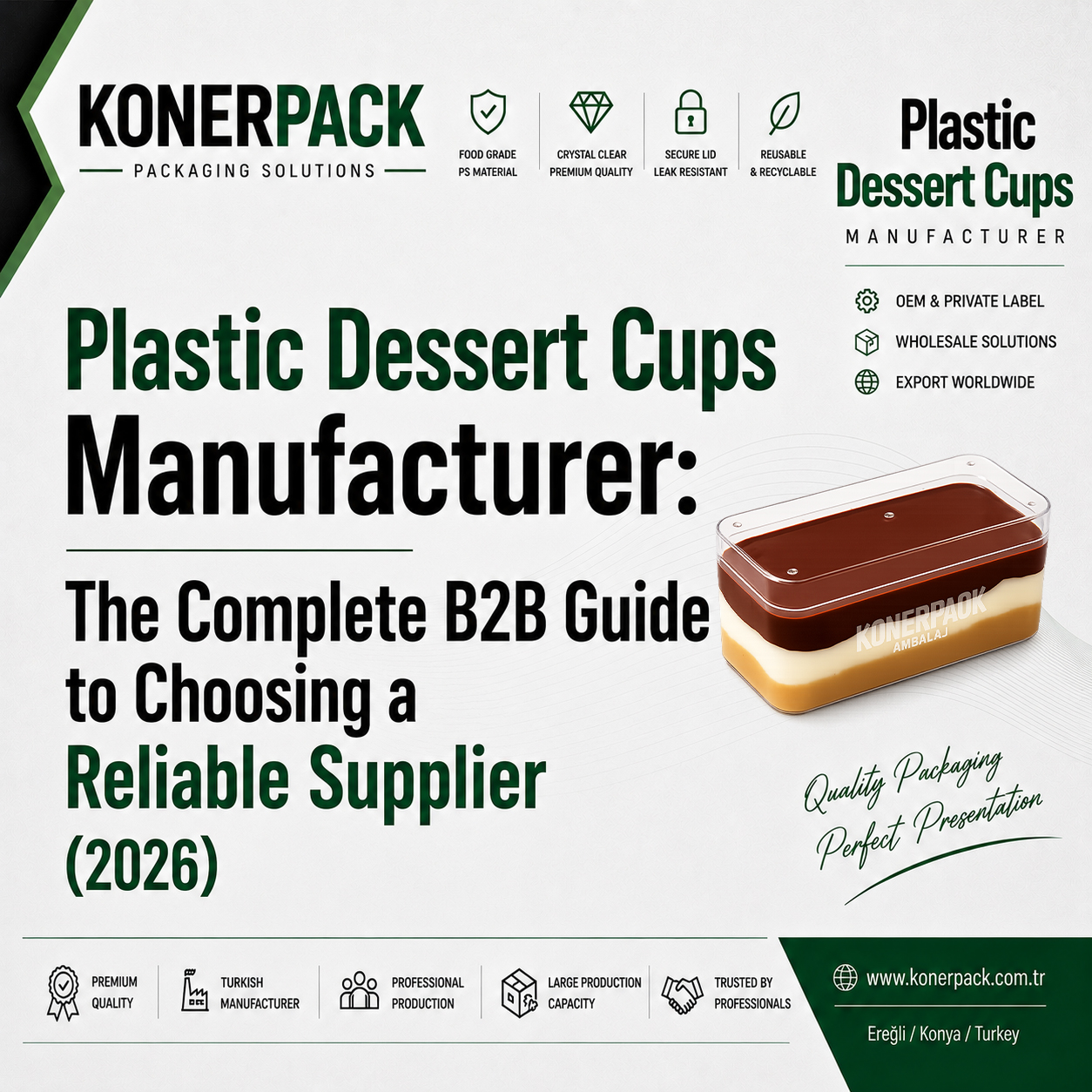
Plastic Dessert Cups Manufacturer: The Complete B2B Guide to Choosing a Reliable Supplier (2026)
Introduction
The global dessert market continues to evolve as cafés, bakeries, hotels, restaurants, catering companies, supermarket chains, and food manufacturers increasingly focus on premium presentation and operational efficiency. Alongside this growth, the demand for high-quality plastic dessert cups has expanded significantly across domestic and international markets.
For importers, wholesalers, distributors, and private label brands, selecting the right plastic dessert cups manufacturer is one of the most important purchasing decisions. The manufacturer you choose directly influences product consistency, customer satisfaction, logistics efficiency, branding opportunities, and long-term business growth.
However, comparing manufacturers is not always straightforward.
Some suppliers specialize in mass production, while others focus on flexible OEM manufacturing. Some provide extensive customization options, whereas others only offer standard products. Prices may vary considerably, but the lowest quotation does not always represent the best long-term value.
Professional buyers therefore evaluate manufacturers based on a combination of technical capability, production quality, communication, export experience, and reliability.
This comprehensive guide has been created to help international B2B buyers understand what truly matters when selecting a plastic dessert cup manufacturer.
Throughout this guide, you will learn:
- What a plastic dessert cup manufacturer actually does
- How manufacturers differ from trading companies
- Which industries use plastic dessert cups
- Why material selection is important
- How OEM and private label production works
- What quality control processes buyers should expect
- How export packaging affects international shipments
- Which questions should be asked before placing a wholesale order
- How to compare suppliers objectively
- What characteristics define a reliable long-term manufacturing partner
Whether you are launching a new dessert brand, expanding your wholesale packaging portfolio, or searching for an experienced OEM supplier, this guide will provide a practical framework for making informed purchasing decisions.
Table of Contents
- What Is a Plastic Dessert Cups Manufacturer?
- Manufacturer vs. Trading Company
- Why Choosing the Right Manufacturer Matters
- Industries That Use Plastic Dessert Cups
- Types of Plastic Dessert Cups
- Materials Used in Dessert Cup Manufacturing
- Understanding PS (Polystyrene) Dessert Cups
- How Plastic Dessert Cups Are Manufactured
- OEM Manufacturing Explained
- Private Label Production
- Custom Logo Printing
- Quality Control & Product Consistency
- Food Contact Considerations
- Export Packaging & International Shipping
- How to Compare Manufacturers
- Questions Every Buyer Should Ask
- Common Purchasing Mistakes
- Why International Buyers Work with Turkish Manufacturers
- Why Choose Konerpack
- Frequently Asked Questions
- Conclusion
What Is a Plastic Dessert Cups Manufacturer?
A plastic dessert cups manufacturer is a company that designs, produces, and supplies food-grade plastic cups intended for serving, displaying, transporting, and presenting individual desserts.
Unlike businesses that simply resell products, manufacturers are responsible for transforming raw materials into finished packaging through controlled production processes.
Depending on their capabilities, a manufacturer may also provide:
- Product design and development
- Mold production and maintenance
- Multiple cup capacities and shapes
- Lid compatibility
- OEM manufacturing
- Private label production
- Custom logo printing
- Export packaging
- Technical documentation
- Long-term production planning
Professional manufacturers work with businesses across many sectors, including bakeries, cafés, hotels, catering companies, restaurant groups, supermarkets, distributors, wholesalers, and food manufacturers.
Because dessert presentation has become an important part of the customer experience, manufacturers continuously develop packaging solutions that combine functionality with an attractive appearance.
For buyers, working directly with a manufacturer often provides greater flexibility, improved product consistency, and more opportunities for customization than purchasing through intermediaries.
Manufacturer vs. Trading Company: Understanding the Difference
One of the first questions international buyers should ask is whether they are dealing directly with a manufacturer or with a trading company.
Although both business models play an important role in global trade, they serve different purposes.
|
Manufacturer |
Trading Company |
|---|---|
|
Produces products in its own facility or manages production directly |
Purchases products from one or more manufacturers |
|
Greater control over production consistency |
Greater flexibility in sourcing from different suppliers |
|
Can often support OEM and private label projects |
Customization depends on manufacturing partners |
|
Provides direct technical knowledge |
May rely on information from manufacturers |
|
Often offers stronger long-term production planning |
Can simplify sourcing from multiple factories |
Neither model is universally better.
For buyers seeking customized dessert cups, consistent product specifications, or long-term OEM cooperation, working directly with a manufacturer may offer additional advantages.
For buyers sourcing multiple unrelated product categories, a trading company may provide convenience by consolidating products from different manufacturers.
Understanding which business model best fits your purchasing strategy helps establish realistic expectations from the beginning of the sourcing process.
Why Choosing the Right Manufacturer Matters
Selecting a plastic dessert cup manufacturer is not simply about finding the lowest quotation.
The right manufacturing partner can contribute to:
- Consistent product quality
- Reliable production planning
- Better customer satisfaction
- Reduced operational risk
- Efficient logistics
- Professional packaging
- Stronger brand identity
- Long-term business growth
By contrast, choosing a supplier solely on price may result in inconsistent product quality, communication challenges, shipment delays, or additional operational costs.
Professional procurement teams therefore evaluate suppliers using structured criteria rather than relying on price comparisons alone.
The following sections of this guide explain those criteria in detail and provide practical recommendations for selecting a manufacturer that supports both your current requirements and your future growth.
Industries That Use Plastic Dessert Cups
Plastic dessert cups are used across a wide range of food service and retail businesses. Although they are commonly associated with cafés and pastry shops, their applications extend far beyond traditional dessert service.
Choosing the right dessert cup depends on several factors, including the type of dessert, serving environment, transportation requirements, presentation goals, and branding strategy.
Below are the industries that most frequently purchase plastic dessert cups in wholesale quantities.
Bakeries & Patisseries
Modern bakeries increasingly rely on individual dessert packaging to improve hygiene, presentation, and operational efficiency.
Plastic dessert cups are commonly used for:
- Tiramisu
- Magnolia desserts
- Chocolate mousse
- Cheesecake
- Pudding
- Layered desserts
- Seasonal specialties
Clear PS dessert cups allow customers to see the product before purchase, making presentation an important part of the buying experience.
Cafés & Coffee Shops
Coffee shops frequently serve desserts alongside beverages.
Plastic dessert cups help cafés:
- Standardize portion sizes
- Improve display quality
- Speed up service
- Simplify takeaway orders
- Maintain consistent product presentation
For specialty cafés, attractive packaging also contributes to social media visibility and brand recognition.
Hotels & Hospitality
Hotels require packaging that combines elegance with operational efficiency.
Typical applications include:
- Breakfast buffets
- Dessert buffets
- Room service
- VIP events
- Banquets
- Conference catering
Consistent cup dimensions and professional presentation support smooth service during high-volume operations.
Catering Companies
Catering businesses often prepare desserts hours before service.
Individual dessert cups help improve:
- Portion consistency
- Hygiene
- Transportation
- Storage
- Fast distribution
- Event presentation
Secure lids are especially valuable when desserts need to be transported between preparation facilities and event venues.
Restaurants
Restaurants increasingly use dessert cups for dine-in, takeaway, and delivery services.
Popular applications include:
- Signature desserts
- Seasonal menus
- Children’s desserts
- Premium plated presentations
- Grab-and-go options
Proper packaging helps preserve appearance until the dessert reaches the customer.
Supermarkets & Retail Chains
Retail-ready dessert packaging requires consistency, attractive presentation, and compatibility with merchandising systems.
Plastic dessert cups are widely used for:
- Refrigerated desserts
- Ready-to-eat products
- Private label dessert lines
- Premium convenience foods
Transparent packaging allows consumers to evaluate the product before purchase, making visual presentation an important sales factor.
Food Manufacturers
Industrial dessert producers require packaging that supports efficient filling, transportation, storage, and distribution.
Manufacturers often prioritize:
- Dimensional consistency
- Reliable lid fit
- Stable stacking
- Production efficiency
- High-volume supply
These requirements make manufacturer consistency particularly important.
Importers & Distributors
Distributors typically look for manufacturers capable of supplying multiple cup models while maintaining consistent quality.
Important purchasing considerations include:
- Product variety
- OEM capabilities
- Private label support
- Export packaging
- Production capacity
- Long-term supply continuity
A broad product portfolio allows distributors to serve multiple customer segments without changing suppliers.
Types of Plastic Dessert Cups
Dessert cups are available in a variety of shapes and capacities. Selecting the appropriate design depends on the dessert being served, the desired presentation, and the target market.
Round Dessert Cups
Round cups remain one of the most popular options because of their versatility.
They are commonly used for:
- Magnolia
- Mousse
- Pudding
- Ice cream desserts
- Fruit desserts
Advantages include:
- Familiar appearance
- Efficient stacking
- Wide product compatibility
- Elegant presentation
Examples within the Konerpack range include the Evva 270 cc and Roma 200 cc models.
Square Dessert Cups
Square cups create a modern, premium appearance while maximizing shelf presentation.
They are suitable for:
- Cheesecake
- Layered desserts
- Premium desserts
- Retail display
Their clean lines often complement contemporary dessert concepts.
An example is the Neva 250 cc dessert cup.
Rectangular Dessert Cups
Rectangular cups provide a distinctive presentation and are frequently selected for layered desserts and premium takeaway products.
Typical applications include:
- Tiramisu
- Magnolia
- Trifle
- Layered desserts
The Nida 270 cc model is an example of this style.
Pyramid Dessert Cups
Pyramid-shaped cups offer a unique visual presentation that enhances premium dessert displays.
They are commonly chosen for:
- Fine dining desserts
- Boutique pastry shops
- Hotel buffets
- Premium catering events
The Dia 200 cc Pyramid Dessert Cup is designed for businesses seeking a more distinctive presentation.
Choosing the Right Capacity
Capacity should be selected according to portion size, menu pricing, and serving style.
|
Capacity |
Typical Applications |
|---|---|
|
150–200 cc |
Tastings, mini desserts, premium portions |
|
200–250 cc |
Cheesecake, mousse, tiramisu, pudding |
|
250–300 cc |
Magnolia, layered desserts, parfaits |
|
300 cc+ |
Large takeaway desserts, specialty desserts |
Rather than choosing the largest available cup, businesses should select a size that supports both product presentation and portion consistency.
Materials Used in Plastic Dessert Cup Manufacturing
Material selection is one of the most important considerations when purchasing dessert cups.
Professional buyers evaluate packaging materials based on:
- Intended food-contact use
- Product appearance
- Transparency
- Rigidity
- Weight
- Manufacturing consistency
- Application requirements
Different materials are available for food packaging, each with its own characteristics.
Common materials include:
- PS (Polystyrene)
- PET (Polyethylene Terephthalate)
- PP (Polypropylene)
The most suitable material depends on the intended use rather than on a single “best” option.
Why PS (Polystyrene) Is Preferred for Premium Dessert Cups
Many premium dessert cups are manufactured from PS (Polystyrene) because it offers characteristics that are particularly well suited to dessert presentation.
Potential advantages include:
- High transparency
- Smooth, glossy appearance
- Good rigidity
- Attractive shelf presentation
- Consistent shape retention
- Professional look and feel
For layered desserts such as tiramisu, magnolia, mousse, and parfait, visual presentation plays a significant role in consumer perception.
The crystal-clear appearance of PS helps highlight dessert layers, textures, and colors.
Konerpack specializes in manufacturing PS dessert cups designed for professional food service, retail, and wholesale applications.
When selecting a material, buyers should always consider the intended application, destination market requirements, and technical product specifications.
How to Choose the Right Dessert Cup
Selecting the ideal dessert cup involves more than choosing a shape or capacity.
Professional buyers typically evaluate:
- Dessert type
- Portion size
- Presentation goals
- Lid compatibility
- Transportation needs
- Storage efficiency
- Branding opportunities
- Filling process
- Target customer
- Sales channel
For example:
- A bakery may prioritize elegant presentation.
- A catering company may prioritize transport stability.
- A supermarket may prioritize shelf appearance.
- A distributor may prioritize product variety and supply continuity.
The most successful purchasing decisions balance visual appeal, operational efficiency, and long-term supply reliability rather than focusing on a single criterion.
How Plastic Dessert Cups Are Manufactured
Understanding how plastic dessert cups are manufactured helps buyers evaluate potential suppliers beyond price alone. A well-controlled manufacturing process contributes to product consistency, dimensional accuracy, visual quality, and reliable performance throughout transportation, storage, and end use.
While production methods may vary depending on the product design and manufacturing technology, professional manufacturers typically follow a structured workflow from raw material preparation to final packaging.
Step 1: Product Design and Engineering
Every successful dessert cup begins with a carefully planned design.
During this stage, engineers define the product’s technical specifications based on its intended application. Important design considerations include:
- Capacity (e.g., 200 cc, 250 cc, 270 cc)
- Shape (round, square, rectangular, pyramid)
- Wall thickness
- Stackability
- Lid compatibility
- Structural rigidity
- Visual appearance
- Manufacturing efficiency
Design decisions also affect transportation costs, storage efficiency, and the overall customer experience.
For B2B buyers developing a new product line, this stage may include collaborative design discussions for OEM or private label projects.
Step 2: Mold Development
Once the product design is finalized, a precision mold is produced.
The mold determines every physical characteristic of the finished cup, including:
- Dimensions
- Surface finish
- Transparency
- Edge quality
- Logo details (if applicable)
- Lid fit
- Wall uniformity
Because molds directly influence product consistency, they represent one of the most important investments in the manufacturing process.
Well-maintained molds help ensure that each production batch remains consistent over time.
Step 3: Raw Material Preparation
The selected raw material is prepared according to the production requirements.
For premium dessert cups manufactured from PS (Polystyrene), consistency in raw material quality is essential for achieving:
- High clarity
- Smooth surface finish
- Uniform wall thickness
- Reliable forming characteristics
- Attractive visual presentation
Proper material handling also helps maintain stable production conditions throughout manufacturing.
Step 4: Cup Forming Process
The prepared material is then processed using industrial manufacturing equipment to produce the final cup shape.
During this stage, manufacturers carefully control parameters such as:
- Temperature
- Pressure
- Forming accuracy
- Cooling time
- Production speed
Maintaining stable production conditions helps reduce variation between batches and supports consistent product quality.
Step 5: Trimming and Finishing
After forming, each cup undergoes trimming and finishing operations.
These processes ensure:
- Smooth edges
- Uniform dimensions
- Clean appearance
- Accurate stacking
- Proper lid compatibility
Even small finishing details can influence the overall perception of product quality.
Step 6: Quality Inspection
Professional manufacturers perform quality inspections throughout production rather than only after products have been completed.
Typical inspection criteria include:
- Dimensional accuracy
- Visual appearance
- Surface quality
- Transparency
- Cup weight
- Structural integrity
- Lid compatibility
- Packaging condition
Continuous inspection helps identify deviations early, reducing waste and supporting production consistency.
Step 7: Packaging
After inspection, products are packaged according to customer requirements.
Packaging may vary depending on:
- Domestic distribution
- Wholesale supply
- Export shipments
- OEM projects
- Private label production
Proper packaging protects products during handling, warehousing, and international transportation.
The Importance of Mold Quality
Many buyers focus primarily on price when comparing manufacturers. However, mold quality has a significant influence on the finished product.
A high-quality mold contributes to:
- Consistent dimensions
- Reliable lid fit
- Smooth surfaces
- Better stacking performance
- Professional appearance
- Lower defect rates
Poorly maintained molds may result in inconsistent cup dimensions, visible surface imperfections, or compatibility issues between cups and lids.
For businesses serving premium markets, consistency is often more valuable than minimal cost savings.
Production Consistency Matters
Wholesale buyers expect every shipment to match previous orders.
Consistency affects:
- Automated filling operations
- Packaging efficiency
- Product presentation
- Customer satisfaction
- Inventory management
- Brand reputation
Reliable manufacturers implement standardized production procedures to maintain consistent quality across production batches.
This is particularly important for distributors, supermarket suppliers, and food manufacturers operating at scale.
Common Manufacturing Defects and How They Are Managed
Even in industrial production, manufacturers monitor for potential quality issues. Effective quality systems focus on prevention rather than correction.
Examples of characteristics that manufacturers routinely inspect include:
|
Inspection Area |
Purpose |
|---|---|
|
Cup dimensions |
Verify consistency between batches |
|
Surface finish |
Ensure a clean and professional appearance |
|
Transparency |
Maintain product presentation quality |
|
Edge quality |
Improve handling and user experience |
|
Lid fit |
Support secure closure and transport |
|
Structural integrity |
Help cups perform during filling and handling |
|
Packaging condition |
Reduce the risk of transport-related damage |
Systematic inspections help manufacturers identify process variations before they affect larger production volumes.
Quality Control Throughout Production
Quality control is not a single inspection performed at the end of production. It is a continuous process that supports consistency from raw material preparation through final packaging.
Professional manufacturers typically establish quality checkpoints at multiple stages, including:
- Incoming material verification
- In-process production checks
- Dimensional measurements
- Visual inspections
- Finished product evaluation
- Packaging verification before shipment
This structured approach helps maintain product reliability while reducing the likelihood of production interruptions or customer complaints.
For international buyers, consistent quality is particularly important because replacing or returning products after export can be costly and time-consuming.
A manufacturer with a well-organized production and quality management process is therefore often a more valuable long-term partner than one competing solely on price.
OEM Manufacturing Explained
Original Equipment Manufacturing (OEM) has become one of the most important business models in the food packaging industry. Instead of purchasing generic products, many distributors, wholesalers, retailers, and food brands choose to work with manufacturers that can produce packaging according to their own commercial requirements.
For companies building a recognizable brand, OEM manufacturing provides greater flexibility and stronger market differentiation than purchasing standard, unbranded products.
What Is OEM Manufacturing?
OEM manufacturing refers to a production model in which a manufacturer produces products according to a customer’s specifications while the finished products are marketed under the customer’s own brand.
Depending on the project, OEM services may include:
- Custom product dimensions
- Exclusive product designs
- Brand-specific packaging
- Private packaging configurations
- Logo printing
- Barcode integration
- Export carton customization
- Special production planning
For distributors serving multiple markets, OEM production can help establish a unique product portfolio that cannot be directly compared with competitors selling generic products.
Benefits of OEM Dessert Cups
Working with an experienced OEM manufacturer offers several commercial advantages.
Stronger Brand Identity
Instead of selling generic packaging, businesses can develop products that reflect their own corporate identity.
Custom branding may include:
- Printed logos
- Company colors
- Custom packaging
- Product labels
- Retail-ready cartons
A consistent visual identity improves brand recognition and supports long-term customer loyalty.
Product Differentiation
Many food service businesses compete in highly competitive markets.
Customized packaging helps create a distinctive customer experience.
Even small visual differences in packaging can increase the perceived value of premium desserts.
Long-Term Supply Stability
OEM partnerships are typically based on long-term cooperation rather than individual transactions.
This enables manufacturers and buyers to coordinate:
- Production schedules
- Forecast planning
- Inventory management
- Seasonal demand
- Export logistics
Long-term planning often improves operational efficiency for both parties.
Private Label Dessert Cups
Private label production is closely related to OEM manufacturing but follows a different commercial approach.
In a private label project, the manufacturer supplies existing product designs while the buyer markets them under their own brand.
This approach allows companies to establish a branded product line without investing in new product development.
Typical private label opportunities include:
- Distributor brands
- Retail chains
- Supermarket brands
- Horeca suppliers
- Regional wholesalers
- Food service distributors
Private label production has become increasingly popular because it combines faster market entry with professional brand presentation.
OEM vs. Private Label
Although these terms are sometimes used interchangeably, they represent different production models.
|
OEM Manufacturing |
Private Label |
|---|---|
|
Product may be developed according to customer specifications |
Existing product design is used |
|
Greater customization potential |
Faster implementation |
|
Higher development flexibility |
Lower development complexity |
|
Suitable for unique product concepts |
Suitable for established product ranges |
The most appropriate solution depends on the buyer’s commercial objectives, expected order volume, and branding strategy.
Custom Printed Dessert Cups
Packaging is no longer viewed solely as a protective container. It has become an important marketing tool that communicates brand identity directly to the end customer.
Custom printed dessert cups help businesses strengthen brand visibility in cafés, bakeries, restaurants, catering services, and retail environments.
Printing options may include:
- Company logo
- Brand name
- Promotional graphics
- Corporate colors
- QR codes
- Marketing messages
- Seasonal campaigns
Professionally printed packaging supports a consistent brand image across multiple customer touchpoints.
Why Branding Matters
Consumers often remember attractive packaging long after they have finished the dessert.
For this reason, many successful food businesses invest in branded packaging that reinforces:
- Product quality
- Brand recognition
- Premium positioning
- Customer trust
For wholesalers and distributors, branded packaging also creates additional value that extends beyond the product itself.
Packaging Solutions for International Export
Export shipments require packaging systems that protect products throughout transportation and storage.
Professional export packaging is designed to reduce the risk of damage while improving warehouse efficiency.
Important considerations include:
- Carton strength
- Stacking performance
- Moisture protection
- Pallet optimization
- Container utilization
- Product identification
- Batch traceability
Well-planned packaging can also simplify customs procedures and inventory management.
Choosing a Manufacturer with Export Experience
International buyers should evaluate more than production capability.
Manufacturers serving export markets should also demonstrate experience in:
- International documentation
- Packaging for long-distance transportation
- Container loading optimization
- Production scheduling
- Communication throughout the order process
Experience with international customers often contributes to smoother cooperation and fewer logistical challenges.
How to Compare Plastic Dessert Cup Manufacturers
Selecting the right supplier requires a structured evaluation process rather than comparing quotations alone.
The following criteria can help buyers make informed decisions.
Product Quality
Evaluate consistency across multiple production batches rather than a single sample.
Consider:
- Transparency
- Surface finish
- Dimensional accuracy
- Structural rigidity
- Lid compatibility
Manufacturing Capability
A capable manufacturer should be able to support future business growth.
Questions to consider include:
- Can production capacity increase if demand grows?
- Are multiple product models available?
- Can customized projects be supported?
Product Portfolio
Working with a manufacturer offering a broad product range can simplify purchasing and reduce supplier management complexity.
Examples include:
- Round dessert cups
- Square dessert cups
- Rectangular dessert cups
- Pyramid dessert cups
- Matching lids
- Various capacities
Communication
Clear communication is essential throughout the sourcing process.
Reliable manufacturers typically provide:
- Timely responses
- Technical information
- Transparent quotations
- Production updates
- Shipment coordination
Long-Term Partnership Potential
The most valuable supplier is not necessarily the lowest-cost supplier.
Instead, buyers should consider whether the manufacturer can support:
- Future product development
- Market expansion
- New packaging concepts
- OEM projects
- Long-term cooperation
Questions Every Buyer Should Ask Before Ordering
Before placing a wholesale order, buyers should obtain clear answers to several key questions.
Product Questions
- Which material is used?
- Which capacities are available?
- Are matching lids available?
- What packaging options are offered?
Production Questions
- What are the standard production lead times?
- How is production quality monitored?
- Can future production volumes be increased?
OEM Questions
- Is custom logo printing available?
- Can private label packaging be supplied?
- Are custom product developments supported?
Export Questions
- How are products packaged for export?
- Which shipping methods are commonly used?
- What documentation accompanies international orders?
Obtaining clear information before production begins helps establish realistic expectations and supports a successful business relationship.
Common Purchasing Mistakes
Many procurement issues arise not because of manufacturing problems, but because buyers focus on only one purchasing criterion.
Common mistakes include:
- Selecting suppliers based solely on price
- Ignoring long-term supply capability
- Overlooking packaging requirements
- Failing to verify lid compatibility
- Not discussing branding requirements early
- Ordering without evaluating communication quality
- Comparing quotations without considering total value
Professional sourcing decisions consider quality, reliability, flexibility, and long-term cooperation alongside pricing.
Why International Buyers Choose Turkish Manufacturers
Turkey has become an important manufacturing hub for food packaging products thanks to its strategic location, developed industrial infrastructure, and strong export capabilities. For international buyers sourcing plastic dessert cups, Turkish manufacturers can offer a balance of production quality, flexibility, and efficient access to markets across Europe, the Middle East, Africa, and beyond.
Rather than evaluating suppliers based solely on their country of origin, professional buyers should assess each manufacturer according to objective business criteria such as production capability, quality management, communication, and long-term partnership potential.
Strategic Geographic Location
Turkey’s location between Europe, Asia, and the Middle East provides logistical advantages for many international markets.
Depending on the destination country and shipping method, this can contribute to:
- Competitive transit times
- Flexible transportation options
- Efficient access to regional markets
- Diversified export routes
For businesses importing regularly, predictable logistics are often as important as production quality.
Manufacturing Experience
Turkey has a well-established manufacturing sector serving numerous industries, including food packaging.
Many manufacturers have experience working with:
- Importers
- Wholesalers
- Horeca suppliers
- Retail chains
- Food manufacturers
- Private label brands
This experience often helps streamline communication and project management throughout the sourcing process.
Flexible Production
Many international buyers require more than standard catalogue products.
Manufacturers with flexible production capabilities may support:
- OEM projects
- Private label production
- Custom packaging
- Logo printing
- Product development
- Long-term supply agreements
This flexibility can be valuable for businesses seeking to differentiate themselves in competitive markets.
Export-Oriented Business Practices
Manufacturers experienced in international trade generally understand the importance of:
- Production scheduling
- Shipment planning
- Export documentation
- Secure packaging
- Clear communication
These operational capabilities contribute to smoother international transactions and long-term business relationships.
Why Choose Konerpack
Selecting a manufacturing partner involves evaluating not only products but also the company’s ability to support your business objectives over time.
Konerpack manufactures plastic dessert cups for professional food service and wholesale applications, with a focus on reliable production, consistent quality, and export-oriented service.
Specialized Product Portfolio
Konerpack focuses on plastic dessert packaging solutions, offering a range of models suitable for different presentation styles and serving requirements.
The product portfolio includes:
- Round dessert cups
- Square dessert cups
- Rectangular dessert cups
- Pyramid dessert cups
- Matching lids
- Multiple capacity options
This variety enables distributors and food service businesses to source multiple product types from a single supplier.
PS Dessert Cup Expertise
Konerpack specializes in manufacturing PS (Polystyrene) dessert cups designed for applications where clarity, presentation, and rigidity are important.
These products are suitable for desserts such as:
- Tiramisu
- Magnolia
- Chocolate mousse
- Cheesecake
- Pudding
- Parfait
- Layered desserts
The crystal-clear appearance of PS highlights the visual appeal of desserts while supporting a premium presentation.
OEM and Private Label Solutions
For distributors and brands seeking customized packaging, Konerpack offers support for OEM and private label projects.
Available services may include:
- Custom logo printing
- Brand-oriented packaging
- Product customization (subject to project requirements)
- Export-ready packaging
- Long-term production planning
International B2B Focus
Konerpack works with business customers such as:
- Importers
- Wholesalers
- Horeca suppliers
- Cafés
- Bakeries
- Hotels
- Catering companies
- Food manufacturers
By focusing on B2B partnerships, the company aims to support customers through consistent production, responsive communication, and reliable supply.
Frequently Asked Questions (FAQ)
1. What is a plastic dessert cups manufacturer?
A plastic dessert cups manufacturer is a company that produces food-grade dessert cups used for serving, displaying, and transporting individual desserts for commercial food service and retail applications.
2. What is the difference between a manufacturer and a supplier?
A manufacturer produces the products, while a supplier may either manufacture the products directly or source them from one or more manufacturers.
3. What material is commonly used for premium dessert cups?
Premium dessert cups are often manufactured from PS (Polystyrene) because of its high clarity, glossy appearance, and rigid structure, making it suitable for visually appealing dessert presentations.
4. Can plastic dessert cups be customized?
Many manufacturers offer customization options such as logo printing, private label packaging, and OEM production, depending on project requirements.
5. What industries use plastic dessert cups?
Plastic dessert cups are widely used by bakeries, cafés, hotels, restaurants, catering companies, supermarkets, food manufacturers, wholesalers, and distributors.
6. Why are transparent dessert cups popular?
Transparent cups showcase dessert layers, textures, and colors, enhancing product presentation and helping attract consumer attention.
7. What capacities are available?
Common capacities include 150 cc, 200 cc, 250 cc, 270 cc, and larger formats for specialty desserts. The ideal size depends on the intended serving portion.
8. Are lids available?
Yes. Many dessert cup models are designed with compatible lids to improve hygiene, transportation, and product protection.
9. What is OEM manufacturing?
OEM manufacturing allows products to be produced according to a customer’s specifications and marketed under the customer’s own brand.
10. What is private label production?
Private label production enables businesses to sell existing product designs under their own brand identity without developing a completely new product.
11. How should I compare manufacturers?
Evaluate manufacturers based on production capability, quality consistency, communication, customization options, export experience, and long-term partnership potential rather than price alone.
12. Why is consistent quality important?
Consistent quality supports reliable filling operations, professional presentation, customer satisfaction, and predictable purchasing outcomes across multiple orders.
13. Which desserts are commonly served in plastic dessert cups?
Popular applications include tiramisu, magnolia, mousse, pudding, parfait, cheesecake, trifle, and layered desserts.
14. Can manufacturers provide branded packaging?
Many manufacturers support branded packaging, including printed logos, custom cartons, and private label solutions.
15. Why do international buyers source from Turkey?
Turkey offers an established manufacturing base, strategic geographic location, export experience, and flexible production capabilities for many international B2B buyers.
Conclusion
Choosing the right plastic dessert cups manufacturer is a strategic decision that extends beyond comparing quotations. A reliable manufacturing partner contributes to consistent product quality, efficient logistics, branding opportunities, and long-term business growth.
Professional buyers should evaluate manufacturers based on objective criteria such as production capability, quality management, communication, product range, customization options, and export experience. This structured approach helps reduce sourcing risks while supporting sustainable commercial partnerships.
For businesses seeking a manufacturer of premium PS plastic dessert cups, it is also important to consider the supplier’s ability to provide OEM production, private label solutions, and packaging designed for international markets.
Whether you are a distributor, importer, food manufacturer, bakery chain, café group, or Horeca supplier, selecting the right manufacturing partner can play a significant role in strengthening your product offering and supporting future growth.
If you are looking for a trusted B2B partner for plastic dessert cups, Konerpack offers a product portfolio designed for professional food service, wholesale distribution, and export markets, with solutions tailored to a wide range of commercial applications.
