
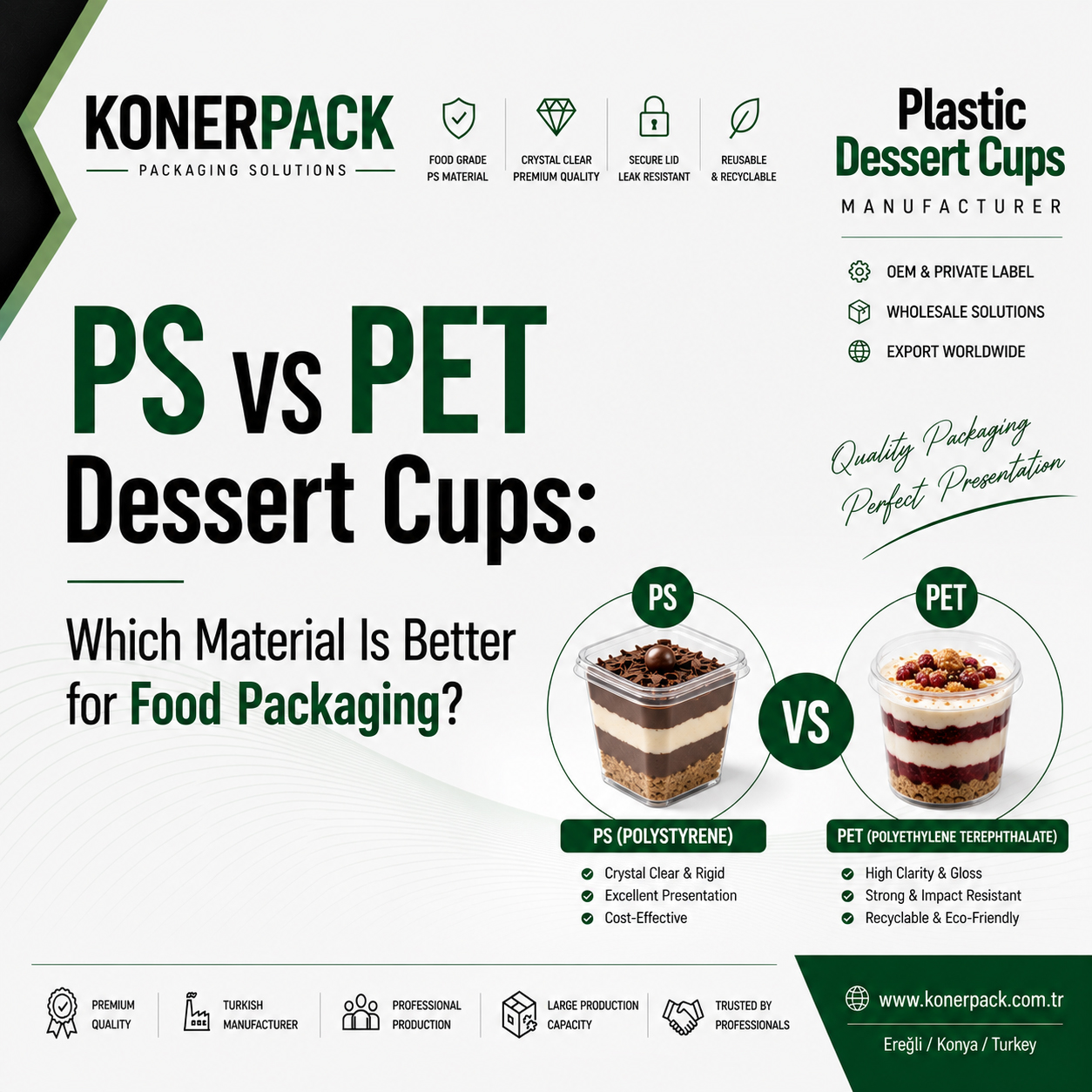
PS vs PET Dessert Cups: Which Material Is Better for Food Packaging?
Quick Answer
Both PS (Polystyrene) and PET (Polyethylene Terephthalate) are widely used in food packaging, but they serve different purposes.
For premium layered desserts, PS dessert cups are often selected because of their excellent rigidity, crystal-clear appearance, and premium shelf presentation.
PET is also a widely used food-contact material and is commonly chosen for applications where higher impact resistance and versatility across various cold food and beverage products are priorities.
The right material depends on the product, branding objectives, transportation conditions, and customer expectations rather than a single property.
At a Glance
|
Feature |
PS |
PET |
|---|---|---|
|
Crystal Clear Appearance |
⭐⭐⭐⭐⭐ |
⭐⭐⭐⭐⭐ |
|
Rigidity |
⭐⭐⭐⭐⭐ |
⭐⭐⭐⭐☆ |
|
Impact Resistance |
⭐⭐⭐⭐☆ |
⭐⭐⭐⭐⭐ |
|
Premium Dessert Presentation |
⭐⭐⭐⭐⭐ |
⭐⭐⭐⭐☆ |
|
Cold Beverage Applications |
⭐⭐⭐☆☆ |
⭐⭐⭐⭐⭐ |
|
Custom Printing Surface |
⭐⭐⭐⭐⭐ |
⭐⭐⭐⭐☆ |
Introduction
Selecting the right material is one of the most important decisions when purchasing plastic dessert cups.
Many buyers focus on design, capacity, or price, but the material itself directly influences product presentation, structural performance, transportation efficiency, and the overall customer experience.
Two of the most common materials used in food packaging are PS (Polystyrene) and PET (Polyethylene Terephthalate).
Although both are suitable for food-contact applications when manufactured according to relevant regulations, they are engineered for different priorities and therefore perform differently depending on the intended use.
For example, a dessert manufacturer producing premium tiramisu may prioritize rigidity and visual clarity, while a beverage company may value impact resistance for cold drink applications.
Understanding these differences helps importers, distributors, cafés, bakeries, restaurants, hotels, and food manufacturers choose packaging that aligns with their operational and branding goals.
In this guide, we compare PS and PET across the criteria that matter most to professional buyers, including appearance, strength, printability, food safety, logistics, and commercial suitability.
What Is PS (Polystyrene)?
Polystyrene (PS) is a widely used thermoplastic material valued in the food packaging industry for its excellent clarity, dimensional stability, and rigid structure.
It is commonly used to manufacture dessert cups that showcase layered products such as:
- Tiramisu
- Magnolia
- Cheesecake
- Chocolate Mousse
- Pudding
- Trifle
- Parfait
- Layered Cream Desserts
Its transparent appearance enhances product visibility, allowing consumers to see every layer of the dessert while maintaining an elegant retail presentation.
For manufacturers, the rigidity of PS helps maintain cup shape during filling, stacking, and display.
Typical Advantages of PS Dessert Cups
✔ Crystal-clear appearance
✔ Excellent rigidity
✔ Smooth, premium surface finish
✔ Consistent dimensional stability
✔ Attractive shelf presentation
✔ Suitable for custom branding and logo printing
✔ Well-suited to layered dessert concepts
Typical Applications
PS dessert cups are commonly used by:
- Bakeries
- Dessert Shops
- Coffee Shops
- Restaurants
- Hotels
- Catering Companies
- Dessert Manufacturers
- Food Packaging Distributors
Expert Insight
For businesses that sell desserts based on visual appeal, packaging transparency and structural stability can significantly influence customer perception. A rigid cup with a clear finish helps preserve the appearance of layered desserts throughout storage, transport, and retail display.
What Is PET (Polyethylene Terephthalate)?
PET (Polyethylene Terephthalate) is another widely used material in the food packaging industry.
It is known for its transparency, durability, and versatility, making it suitable for a broad range of cold food and beverage packaging applications.
PET is commonly found in products such as:
- Cold beverage cups
- Salad containers
- Fruit packaging
- Deli containers
- Cold dessert packaging
- Ready-to-eat food containers
Its combination of clarity and impact resistance makes it a popular choice in applications where products may be handled frequently during transportation or retail distribution.
Typical Advantages of PET
✔ Excellent transparency
✔ High impact resistance
✔ Lightweight construction
✔ Good dimensional consistency
✔ Suitable for cold food and beverage applications
✔ Attractive retail appearance
Typical Applications
PET is widely used for:
- Cold drinks
- Smoothies
- Iced coffee
- Fresh fruit
- Salads
- Cold desserts
- Grab-and-go retail packaging
Did You Know?
Although both PS and PET can appear similarly transparent to the consumer, manufacturers evaluate materials using many additional criteria, including rigidity, intended application, production method, transportation conditions, and branding requirements. Material selection is therefore based on the complete packaging strategy rather than appearance alone.
Why Material Selection Matters
Choosing the right material affects much more than the appearance of the final product.
It can influence:
- Customer perception
- Filling efficiency
- Transportation performance
- Product protection
- Shelf presentation
- Branding opportunities
- Production consistency
- Packaging costs
- Operational efficiency
For professional food businesses, selecting packaging material is therefore a strategic decision that should align with both product requirements and commercial objectives.
Key Takeaways
✔ PS and PET are both widely used food packaging materials.
✔ Each material offers different performance characteristics depending on the intended application.
✔ PS is frequently selected for premium dessert presentation because of its rigidity and elegant appearance.
✔ PET is commonly used across a broad range of cold food and beverage packaging applications.
✔ Material selection should consider product type, branding goals, logistics, and customer expectations—not only purchase price.
Technical Comparison: PS vs PET Dessert Cups
Although PS and PET are both transparent food-contact plastics, they have different physical properties that influence how they perform in real-world applications.
Professional buyers should compare materials based on performance, not assumptions. Factors such as rigidity, impact resistance, printability, logistics, and intended use all play an important role in selecting the right packaging.
The following comparison highlights the characteristics that matter most when choosing dessert cups.
PS vs PET Comparison Table
|
Feature |
PS (Polystyrene) |
PET (Polyethylene Terephthalate) |
|---|---|---|
|
Transparency |
Excellent |
Excellent |
|
Surface Gloss |
Excellent |
Excellent |
|
Rigidity |
Excellent |
Good |
|
Impact Resistance |
Good |
Excellent |
|
Dimensional Stability |
Excellent |
Good |
|
Stackability |
Excellent |
Good |
|
Printing Surface |
Excellent |
Very Good |
|
Premium Shelf Appearance |
Excellent |
Very Good |
|
Suitable for Layered Desserts |
Excellent |
Very Good |
|
Typical Applications |
Premium Dessert Packaging |
Cold Food & Beverage Packaging |
Transparency and Visual Presentation
Presentation is one of the most important selling points for desserts.
Consumers often make purchasing decisions based on appearance before tasting the product.
Both PS and PET provide excellent transparency, allowing dessert layers to remain visible. However, premium dessert concepts often prioritize not only clarity but also structural stability and a refined surface finish.
A well-designed transparent cup helps highlight:
- Cream layers
- Chocolate layers
- Fruit toppings
- Biscuit bases
- Decorative sauces
- Premium garnishes
For businesses investing in premium dessert presentation, packaging quality becomes part of the overall customer experience.
Expert Tip
Packaging should complement the dessert—not compete with it. A transparent cup with a clean finish allows the product itself to become the visual focus.
Rigidity and Structural Performance
Rigidity influences how a dessert cup performs during production, transportation, stacking, and retail display.
A rigid cup is less likely to deform during filling or while being handled throughout the supply chain.
For businesses producing layered desserts, maintaining the original shape of the cup helps preserve presentation quality from the production line to the customer.
Why Rigidity Matters
- More stable during filling
- Better stacking performance
- Improved shelf presentation
- Reduced risk of deformation
- Consistent dimensions for lid compatibility
Did You Know?
Even a small amount of deformation can affect how dessert layers appear through a transparent cup. Structural consistency is therefore an important consideration for premium dessert packaging.
Impact Resistance
Impact resistance describes how well a packaging material withstands accidental drops or handling during transportation.
PET is generally recognized for offering higher impact resistance, making it suitable for applications involving frequent handling or movement.
Businesses should consider transportation conditions when evaluating packaging materials, particularly for long-distance distribution.
Printing Performance
Many food businesses strengthen their brand through custom-printed packaging.
Both PS and PET can be used for printed applications, but successful printing depends on multiple factors, including:
- Printing technology
- Ink system
- Surface preparation
- Artwork quality
- Production process
A smooth and consistent surface contributes to professional branding and clear logo reproduction.
Typical Printed Applications
- Bakery logos
- Coffee shop branding
- Dessert chain identity
- Promotional campaigns
- Private label products
- OEM production
Stackability and Logistics
Packaging efficiency extends beyond the individual cup.
Professional buyers also evaluate:
- Stackability
- Carton optimization
- Warehouse storage
- Pallet utilization
- Shipping efficiency
Well-designed cups that stack consistently can simplify inventory management and improve transportation efficiency.
Logistics Benefits
✔ Easier warehouse handling
✔ Better pallet stability
✔ Improved carton utilization
✔ Faster production workflow
✔ Reduced storage space
Food Contact Suitability
Both PS and PET are commonly used in food packaging when manufactured in accordance with applicable food-contact regulations.
When sourcing dessert cups, buyers should confirm that products are manufactured using food-grade raw materials and comply with the regulatory requirements of the destination market.
In addition to material selection, buyers should evaluate:
- Manufacturing quality
- Traceability
- Production consistency
- Quality assurance procedures
- Packaging integrity
Food safety depends on the complete manufacturing process—not solely on the type of plastic.
Expert Insight
Professional buyers increasingly evaluate suppliers based on documented quality systems and manufacturing consistency rather than focusing exclusively on the material itself. Reliable production processes are essential for maintaining long-term product quality.
Advantages and Considerations
PS Dessert Cups
Advantages
- Excellent rigidity
- Premium visual presentation
- Smooth surface finish
- Strong stacking performance
- Attractive branding opportunities
- Ideal for layered desserts
Considerations
- Material selection should match the intended application and logistics requirements.
PET Dessert Cups
Advantages
- Excellent impact resistance
- High transparency
- Lightweight construction
- Broad range of cold food and beverage applications
- Suitable for retail distribution
Considerations
- Packaging should always be selected according to product type, production process, and customer expectations.
Decision Matrix
|
Business Priority |
Recommended Material |
|---|---|
|
Premium Layered Desserts |
PS |
|
Luxury Dessert Presentation |
PS |
|
Standard Retail Desserts |
PS or PET (depending on application) |
|
Cold Beverage Packaging |
PET |
|
Grab-and-Go Cold Food |
PET |
|
Custom Printed Dessert Cups |
PS or PET (based on production requirements) |
Key Takeaways
✔ Both PS and PET provide excellent transparency for food packaging.
✔ PS is widely chosen for premium dessert concepts that emphasize presentation and rigidity.
✔ PET is commonly selected for applications where impact resistance and versatility are important.
✔ Material selection should be based on the intended use, logistics, branding objectives, and operational needs.
✔ Choosing the right manufacturing partner is just as important as selecting the right material.
Which Material Is Best for Different Dessert Types?
There is no single packaging material that is universally “better” for every dessert. The ideal choice depends on the recipe, presentation style, transportation requirements, and the expectations of your target customers.
Professional dessert manufacturers rarely select packaging based on material alone. Instead, they evaluate the complete packaging system, including dessert appearance, production efficiency, storage conditions, branding opportunities, and distribution requirements.
The following recommendations illustrate how different dessert categories can benefit from different material characteristics.
Tiramisu
Tiramisu is one of the most visually appealing layered desserts. Customers expect to clearly see every layer of mascarpone cream, coffee-soaked sponge, and cocoa topping before making a purchase.
Because presentation plays such an important role, many manufacturers prefer rigid, crystal-clear packaging that preserves the dessert’s structure during filling, transportation, and refrigerated display.
Recommended Cup Size
270cc
Recommended Cup Style
Rectangular or Round Premium Cup
Recommended Product
NIDA 270cc Plastic Dessert Cup
Magnolia Desserts
Magnolia desserts typically contain multiple soft layers, biscuit crumbs, cream, fruit, and decorative toppings.
The packaging should provide sufficient space without making the portion appear too large or too small.
Recommended Cup Size
250cc
or
270cc for premium concepts.
Recommended Products
NEVA 250cc
EVVA 270cc
BODEGA 250cc
Cheesecake
Individual cheesecakes require a balanced portion that allows enough room for sauces, fruit toppings, or biscuit layers.
For most bakeries and cafés, a medium-capacity cup offers the best balance between presentation and food cost.
Recommended Cup Size
250cc
Chocolate Mousse
Chocolate mousse is light, creamy, and often decorated with whipped cream, chocolate curls, berries, or sauces.
Depending on the serving concept:
200cc is suitable for tasting portions.
250cc works well for everyday retail sales.
270cc supports premium dessert presentations.
Fruit Parfaits
Fruit parfaits benefit from taller packaging because the colorful fruit layers become part of the visual presentation.
A larger cup also provides enough space for yogurt, granola, sauces, and fresh fruit without compressing the ingredients.
Recommended Size
270cc
Pudding
Traditional puddings usually require a simple, economical packaging solution.
A medium-sized cup provides an attractive appearance while maintaining efficient ingredient usage.
Recommended Size
250cc
Trifle and Layered Desserts
Layered desserts rely heavily on visual presentation.
Visible cream layers, sponge cake, fruit, chocolate, and sauces are often the primary selling point.
For these products, larger capacities generally provide more creative freedom for chefs and pastry professionals.
Recommended Size
270cc
Choosing the Right Material by Business Type
Different businesses prioritize different performance characteristics.
A bakery focuses on presentation.
A hotel emphasizes operational efficiency.
A distributor considers product variety.
An exporter evaluates logistics and consistency.
Selecting packaging based on the actual business model leads to better long-term results than selecting a single universal solution.
Bakeries
Primary Priorities
- Attractive presentation
- Portion consistency
- Premium appearance
- Customer perception
Recommended Capacity
250cc–270cc
Cafés
Primary Priorities
- Everyday usability
- Balanced portions
- Takeaway compatibility
- Shelf presentation
Recommended Capacity
250cc
Restaurants
Primary Priorities
- Elegant presentation
- Controlled portions
- Premium serving experience
Recommended Capacity
200cc for tasting menus
250cc–270cc for standard desserts
Hotels
Primary Priorities
- Operational efficiency
- Buffet flexibility
- Multiple serving concepts
Recommended Capacity
200cc
250cc
270cc
depending on service type.
Catering Companies
Primary Priorities
- Transportation
- Portion control
- Fast production
- Easy distribution
Recommended Capacity
200cc–250cc
Dessert Manufacturers
Primary Priorities
- Filling line compatibility
- Consistent dimensions
- Stackability
- Reliable lid fit
- Production efficiency
Many manufacturers maintain multiple cup sizes to serve different market segments.
Importers & Distributors
Professional distributors rarely stock only one product.
Instead, they typically build a complete portfolio including multiple capacities and shapes to meet the needs of bakeries, cafés, restaurants, hotels, and wholesalers.
Offering several compatible product options improves customer satisfaction and increases sales opportunities.
Common Buyer Mistakes
Even experienced purchasing managers occasionally make packaging decisions that reduce efficiency or increase costs.
The most common mistakes include:
- Selecting packaging based only on the lowest unit price.
- Choosing one cup size for every dessert.
- Ignoring transportation and storage requirements.
- Forgetting to evaluate lid compatibility.
- Underestimating the importance of presentation.
- Not requesting production samples before placing wholesale orders.
- Working with suppliers that cannot guarantee consistent quality.
Avoiding these mistakes helps reduce operational risks while improving the overall customer experience.
Expert Recommendation
Instead of asking “Which material is better?”, professional buyers should ask:
- Which material best supports my dessert?
- Which material aligns with my brand positioning?
- Which material performs best throughout production, transportation, and retail display?
- Which manufacturer can consistently deliver the required quality?
The right packaging decision is always based on the complete business model rather than a single technical specification.
Material Selection Checklist
Before placing your next order, confirm the following:
✔ Food-grade material suitable for the intended application
✔ Appropriate capacity for the dessert
✔ Compatible lid system
✔ Reliable stacking performance
✔ Clear and attractive presentation
✔ Consistent production quality
✔ Branding or custom printing options
✔ Export-ready packaging
✔ Reliable delivery schedule
✔ Long-term manufacturing support
Key Takeaways
✔ Material selection should support both product quality and business objectives.
✔ Premium dessert presentation depends on a combination of transparency, structural stability, and thoughtful package design.
✔ Different dessert types benefit from different capacities and packaging concepts.
✔ Successful importers and distributors build complete product portfolios rather than relying on a single size or style.
✔ Choosing the right manufacturing partner is just as important as choosing the right material.
Frequently Asked Questions
What is the difference between PS and PET dessert cups?
PS (Polystyrene) and PET (Polyethylene Terephthalate) are both food-contact plastics commonly used for dessert packaging. PS is often selected for premium dessert presentation because of its rigidity and crystal-clear appearance, while PET is widely used for cold food and beverage packaging where impact resistance is an important consideration.
Which material is better for layered desserts?
Layered desserts such as tiramisu, parfait, trifle, and magnolia benefit from packaging that highlights the visible layers and maintains its shape throughout filling, transportation, and display. The most suitable material depends on the product concept, presentation goals, and operational requirements.
Are PS dessert cups food safe?
When manufactured from food-grade raw materials and produced in accordance with applicable food-contact regulations, PS dessert cups are suitable for direct food contact.
Are PET dessert cups food safe?
Yes. PET is also widely used for food-contact packaging, particularly for cold food and beverage applications, provided it complies with the regulations applicable to the destination market.
Which material is clearer?
Both PS and PET offer excellent transparency. The perceived appearance may vary depending on the product design, manufacturing quality, and wall thickness.
Which material is more rigid?
PS generally provides greater rigidity, making it a popular choice for premium dessert cups where maintaining shape and presentation is important.
Which material is more impact resistant?
PET is generally recognized for its higher impact resistance, making it suitable for applications involving frequent handling or transportation.
Can both materials be printed?
Yes. Both PS and PET can be customized with logo printing, branding, and private label designs using suitable printing technologies.
Which material is better for cafés?
The most appropriate material depends on the menu, dessert style, branding strategy, and operational workflow rather than the business type alone.
Which material is recommended for bakeries?
Many bakeries choose packaging that provides excellent presentation, consistent dimensions, and an attractive retail appearance. The final decision should match the specific dessert concept and production process.
Which material is suitable for takeaway desserts?
Both materials can be used for takeaway applications when paired with compatible lids and selected according to the product’s handling and transportation requirements.
Can I order custom-printed dessert cups?
Yes. Many manufacturers provide OEM and private label services, including custom logo printing, branded packaging, and customized carton labeling.
What should importers consider before choosing a material?
Professional buyers should evaluate:
- Product presentation
- Material performance
- Production consistency
- Food-contact compliance
- Printing requirements
- Logistics
- Supplier reliability
- Long-term availability
Is material more important than cup size?
Material and capacity work together. The best packaging solution combines the right material, the correct cup size, and a design suitable for the intended dessert.
How do I choose the right manufacturer?
Choose a manufacturer that offers consistent quality, food-grade production, technical support, export experience, and a complete product portfolio rather than focusing only on unit price.
Comparison Summary
|
Criteria |
PS |
PET |
|---|---|---|
|
Premium Dessert Presentation |
Excellent |
Very Good |
|
Rigidity |
Excellent |
Good |
|
Impact Resistance |
Good |
Excellent |
|
Transparency |
Excellent |
Excellent |
|
Printing Performance |
Excellent |
Very Good |
|
Cold Beverage Applications |
Suitable |
Excellent |
|
Typical Use |
Premium Dessert Packaging |
Cold Food & Beverage Packaging |
Related Products
Explore Konerpack’s food-grade PS dessert cup collection designed for professional dessert businesses.
EVVA 270cc
A premium round dessert cup ideal for layered desserts, parfaits, mousses, and gourmet presentations.
NEVA 250cc
A modern square dessert cup designed for magnolia, cheesecake, pudding, and everyday dessert applications.
NIDA 270cc
A rectangular dessert cup developed specifically for tiramisu and premium bakery presentations.
ROMA 200cc
A stylish footed dessert cup suitable for hotels, restaurants, and catering events.
DIAMOND 200cc
A compact square dessert cup ideal for tasting menus, buffets, and individual servings.
BODEGA 250cc
A classic round dessert cup offering versatility for a wide range of dessert recipes.
Related Articles
Continue exploring our expert guides:
- Plastic Dessert Cups – The Ultimate B2B Buying Guide (2026)
- Plastic Dessert Cup Sizes Explained (200cc, 250cc & 270cc)
- Best Plastic Dessert Cups for Tiramisu
- Best Plastic Dessert Cups for Magnolia
- OEM & Private Label Dessert Cups
- How to Choose a Plastic Dessert Cup Manufacturer
- Wholesale Plastic Dessert Cups Guide
- Dessert Packaging Trends 2026
Why Choose Konerpack?
Konerpack manufactures premium food-grade PS plastic dessert cups for professional food businesses worldwide.
Our product range is designed to meet the needs of bakeries, cafés, restaurants, hotels, catering companies, wholesalers, distributors, and international importers.
By combining modern production technology with consistent manufacturing standards, we help businesses improve dessert presentation while supporting efficient production and reliable supply.
Whether you require standard packaging or customized OEM and private label solutions, our team is committed to delivering products that support long-term business success.
Conclusion
Choosing between PS and PET dessert cups is not about identifying a universally superior material—it is about selecting the material that best supports your product, production process, brand positioning, and customer expectations.
For premium layered desserts where presentation and structural rigidity are priorities, PS is frequently chosen because of its clarity and elegant appearance.
For applications that benefit from higher impact resistance and broader cold food or beverage compatibility, PET may be an appropriate choice.
The most successful businesses evaluate packaging as part of an integrated strategy that includes material selection, cup size, design, logistics, branding, and manufacturing quality.
Working with an experienced manufacturer ensures that every element of this strategy contributes to a consistent and professional customer experience.
Looking for Premium PS Dessert Cups?
If your business is searching for high-quality food-grade PS plastic dessert cups for bakeries, cafés, restaurants, hotels, catering companies, or international distribution, Konerpack offers a comprehensive range of solutions.
Our portfolio includes multiple capacities, modern designs, OEM production, and private label services tailored to professional B2B customers.
Contact our team to discuss wholesale requirements, export projects, or customized packaging solutions.
